Creative testing on Meta: Reels-first production, hooks and how many ads to run
By The Clear Path Media House team · · 6 min read
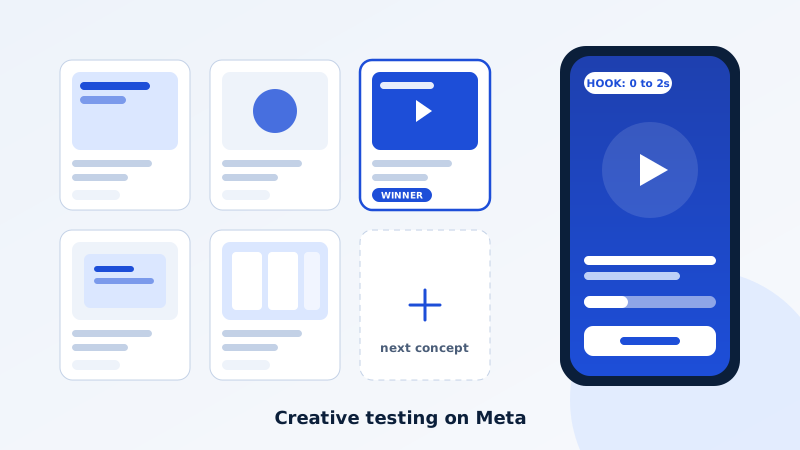
Ask a Meta specialist in 2026 what moved the needle on an account and the answer is almost always creative. Not a bidding trick, not a secret audience. A new concept, a better hook, a format that finally fit the placement. Yet many businesses still produce creative the way they did for print: one polished asset, approved by committee, run until someone notices it stopped working. This article covers how we produce and test creative for Facebook and Instagram, with Reels as the starting point, and how many ads a sensible test actually needs.
Why creative is the targeting now
With Advantage+ audience and broad targeting, you no longer tell Meta in detail who to reach. The delivery system watches who engages with each ad in its first hours and expands toward people like them. Each creative concept therefore selects its own audience. An ad that opens with a pain point about back pain at a desk reaches office workers; the same product opened with a clip from a hike reaches a different group entirely. Diversity of concepts is diversity of audiences, and a batch of near-identical ads with different background colors tests nothing.
It also means creative fatigue is an audience problem. When frequency rises and results fall, the system has run out of people who respond to that concept at an acceptable cost. The fix is rarely a new audience setting. It is a new concept.
Reels-first production without a studio
Reels placements on Instagram and Facebook reward video that looks like it belongs in the feed: vertical 9:16, a person or product on screen immediately, captions for sound-off viewing, a cut every few seconds, and under thirty seconds for most offers. Polished brand films shrunk to vertical usually lose to clips shot on a phone by someone who knows the product.
Our process for a monthly batch is simple. We collect raw material: product footage, a founder or technician answering common questions on camera, customer reviews we can put on screen as text, screen recordings for software. We write several scripts, each built on a different angle: a problem, a demonstration, a comparison, a customer story, an objection answered. We edit each script into a Reel, cut a 4:5 version for Feed, and export stills for statics and carousels. One recording session can produce a month of distinct concepts if the scripts are planned before anyone presses record.
Hooks: the first two seconds decide the cost
On Reels, people decide to stay or scroll in roughly two seconds. The hook, meaning what is on screen and what is said or shown in that window, determines how many people see the rest of the ad, and therefore how much each result costs. We treat hooks as a separate variable. For each concept we produce three to five opening variations and keep the body identical: opening with the result, opening with the problem, opening with a bold on-screen statement, opening with the product in use.
Measure hooks with the three-second video play rate and the thumb-stop ratio, which is three-second plays divided by impressions. A concept that holds attention but never converts has a body problem. A concept that converts well but earns few views has a hook problem. Separating the two tells you what to fix next.
Advantage+ creative: when to let Meta edit your ads
Advantage+ creative is a set of automatic enhancements: adjusting brightness and contrast, cropping per placement, adding music, generating text variations, animating statics, and in some cases expanding images with generative tools. For carefully produced Reels we usually leave the visual enhancements off, because the system can crop out captions or change pacing. For statics and catalog ads, enhancements such as placement-specific cropping and text optimization often help.
The practical rule is to review each enhancement per ad and check the preview for every placement before publishing. Treat Advantage+ creative as an assistant with opinions: useful when it fills a gap, harmful when it edits something you designed on purpose.
How many ads to test, and how to structure the test
More ads is not better. Each ad needs enough impressions and conversions to be judged, and spreading a modest budget across twenty variations produces twenty inconclusive results. For most accounts we test three to five distinct concepts at a time, each with two or three hook variations, inside one ad set with a budget large enough to exit the learning phase. The delivery system will favor one or two ads quickly. That is fine, because the test is about finding concepts that scale, not about giving every ad equal spend.
For big strategic questions, such as one brand voice against another, use Meta's A/B test tool so audiences do not overlap. For routine creative rotation, the single ad set approach is faster and cheaper. Give any test at least a week and enough conversions to mean something before declaring a result, and never pause an ad in its first three days because of one bad afternoon.
Reading the results and deciding what to make next
Judge creative on cost per result and conversion rate first, then on the diagnostics: thumb-stop ratio, hold rate at fifteen seconds, outbound click-through rate and frequency. Keep a simple document listing each concept, its angle, its hook and its results. Over a few months the document becomes a map of what your market responds to, and the next batch stops being a guess.
When a concept wins, iterate it: new hooks, a different presenter, a longer or shorter cut, a static version. When a concept loses twice with different hooks, retire the angle, not just the ad. And keep one or two wild cards in every batch, because the best-performing angle is often the one nobody would have approved on paper.
Key takeaways
- Creative selects the audience; diversity of concepts is diversity of reach.
- Produce Reels-first: vertical, captioned, fast cuts, native feel. One planned session can yield a month of concepts.
- Treat hooks as a separate variable and measure thumb-stop ratio and hold rate.
- Review Advantage+ creative per ad: usually off for crafted Reels, often on for statics and catalog ads.
- Test three to five concepts with two or three hooks each in one ad set with enough budget, and give it a week.
- Keep a creative log, iterate winners and retire losing angles.
Creative production and structured testing are part of every engagement we run, from scripts to Reels edits to the monthly review. If you want a team that treats creative as the main lever it is, get in touch and tell us what you sell.